Pesquisar neste blogue

23 novembro 2020

Oxford/AZ Vaccine Efficacy Data

Oxford/AZ Vaccine Efficacy Data: What was announced today is that they have quite different results for two different dosing regimens. This interim analysis was run when 131 cases had been accrued across trials in the UK, Brazil, and South Africa across about 24,000 trial participants (treatment and control groups). In the treatment group, 8,895 participants received two full doses of the vaccine, spaced one month apart, and 2,741 patients got a half dose at first, followed by a full dose a month later. And the efficacy rates for these two dosing regimes were very different: 62% for the two-full-dose group and 90% for the half/full group. I do not see a breakdown of how those 131 cases partitioned across the two groups, but the overall N has to be higher for the first, doesn’t it? I’d like to know what the statistics are for the 90% efficacy number, for sure.

Why might there be such a significant split in efficacy?

Dosing error turns into lucky punch for AstraZeneca and Oxford: A stroke of good fortune from a dosing error will pave the way for AstraZeneca and Oxford University to submit their COVID-19 vaccine for regulatory clearance.

The British drugmaker said on Monday that the vaccine could be around 90% effective, when administered as a half dose followed by a full dose a month later, citing data from late-stage trials in Britain and Brazil.


Why emergency COVID-vaccine approvals pose a dilemma for scientists

Why emergency COVID-vaccine approvals pose a dilemma for scientists: After a flurry of positive results from clinical trials of COVID-19 vaccines, developers are now seeking ‘emergency use’ approvals, which could see these immunizations deployed in potentially tens of millions of people. But scientists are concerned that this kind of early deployment could compromise the ongoing clinical trials that seek to show conclusively how well the vaccines work. 

Once a vaccine is granted emergency approval, there is pressure on developers to offer the immunization to trial participants who received a placebo. But if too many people cross over to the vaccine group, the companies might not have enough data to establish long-term outcomes, such as safety, how long vaccine protection lasts and whether the jab prevents infection or just the disease.

This coronavirus vaccine would be two breakthroughs in one

This coronavirus vaccine would be two breakthroughs in one: Amid the global coronavirus pandemic, waiting the normal length of time for a vaccine seems unbearable. And so, despite being relatively unproven – only a handful of mRNA vaccines have ever entered clinical trials, and none have progressed to public use – mRNA vaccines have been seized on as a candidate to solve the problem. Not only to stop the pandemic, but to do it quickly.

Hong Kong to Give $645 to Those Found With Covid-19

Hong Kong to Give $645 to Those Found With Covid-19: Hong Kong will give a one-time HK$5,000 ($645) payment to anyone in the city who tests positive for Covid-19 to encourage people to take tests for the virus, Health Secretary Sophia Chan said.

Post-lockdown SARS-CoV-2 nucleic acid screening in nearly ten million residents of Wuhan

Post-lockdown SARS-CoV-2 nucleic acid screening in nearly ten million residents of Wuhan, China: Stringent COVID-19 control measures were imposed in Wuhan between January 23 and April 8, 2020. Estimates of the prevalence of infection following the release of restrictions could inform post-lockdown pandemic management. Here, we describe a city-wide SARS-CoV-2 nucleic acid screening programme between May 14 and June 1, 2020 in Wuhan. All city residents aged six years or older were eligible and 9,899,828 (92.9%) participated. No new symptomatic cases and 300 asymptomatic cases (detection rate 0.303/10,000, 95% CI 0.270–0.339/10,000) were identified. There were no positive tests amongst 1,174 close contacts of asymptomatic cases. 107 of 34,424 previously recovered COVID-19 patients tested positive again (re-positive rate 0.31%, 95% CI 0.423–0.574%). The prevalence of SARS-CoV-2 infection in Wuhan was therefore very low five to eight weeks after the end of lockdown.

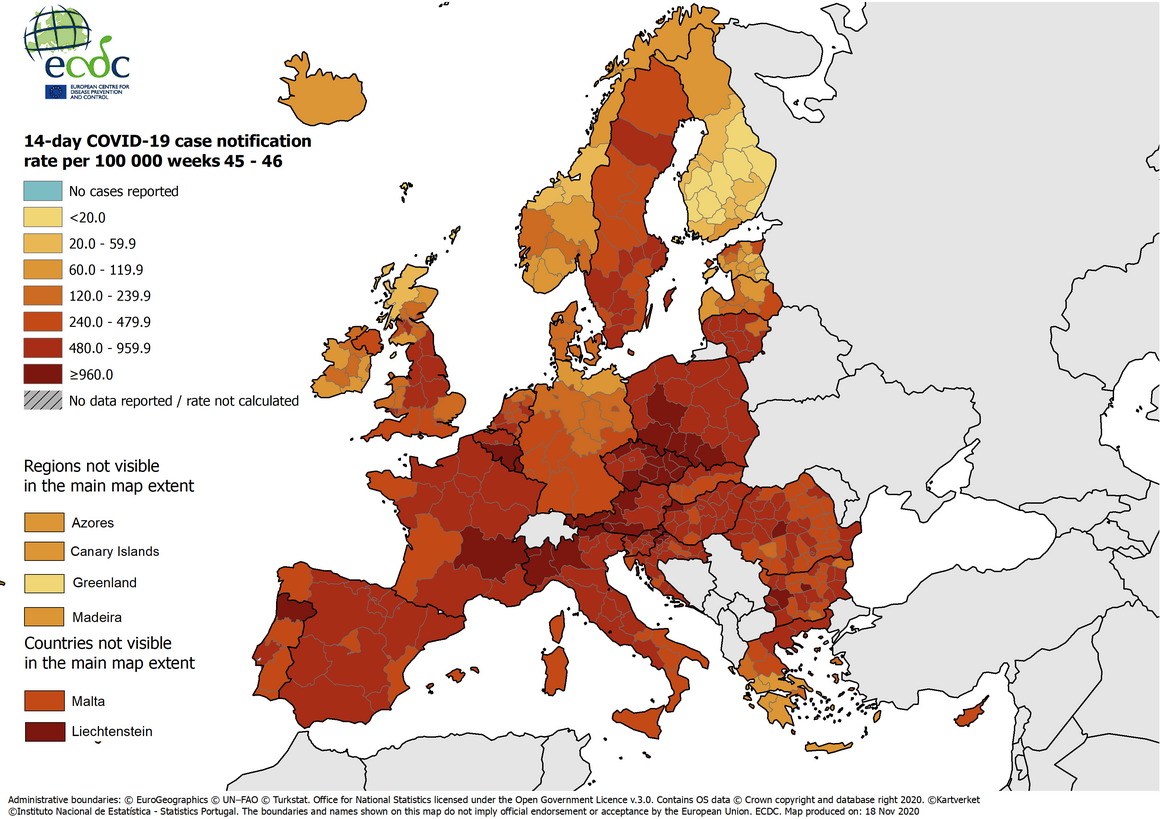
COVID-19 situation update for the EU/EEA and the UK, as of 23 November 2020

COVID-19 situation update for the EU/EEA and the UK: As of 23 November 2020, 12 051 640 cases have been reported in the EU/EEA and the UK: Portugal (260 758)

14-day COVID-19 case notification rate per 100 000, weeks 45-46

What you need to know about the coronavirus pandemic on 23 November

COVID-19: What you need to know about the coronavirus pandemic on 23 November | World Economic Forum: Top stories: G20 vow to ensure equal vaccine access; US cases pass 12 million; France announces plan to exit lockdown.