Pesquisar neste blogue

23 outubro 2020

Magnitude, demographics and dynamics of the effect of the first wave of the COVID-19 pandemic on all-cause mortality in 21 industrialized countries

Magnitude, demographics and dynamics of the effect of the first wave of the COVID-19 pandemic on all-cause mortality in 21 industrialized countries | Abstract: The Coronavirus Disease 2019 (COVID-19) pandemic has changed many social, economic, environmental and healthcare determinants of health. We applied an ensemble of 16 Bayesian models to vital statistics data to estimate the all-cause mortality effect of the pandemic for 21 industrialized countries. From mid-February through May 2020, 206,000 (95% credible interval, 178,100–231,000) more people died in these countries than would have had the pandemic not occurred. The number of excess deaths, excess deaths per 100,000 people and relative increase in deaths were similar between men and women in most countries. England and Wales and Spain experienced the largest effect: ~100 excess deaths per 100,000 people, equivalent to a 37% (30–44%) relative increase in England and Wales and 38% (31–45%) in Spain. Bulgaria, New Zealand, Slovakia, Australia, Czechia, Hungary, Poland, Norway, Denmark and Finland experienced mortality changes that ranged from possible small declines to increases of 5% or less in either sex. The heterogeneous mortality effects of the COVID-19 pandemic reflect differences in how well countries have managed the pandemic and the resilience and preparedness of the health and social care system.

With our consistent and comparable analysis, we identified four groups of countries in terms of the overall death toll of the first wave of the COVID-19 pandemic. The first group comprises countries that have avoided a detectable rise (with a posterior probability of at least 90%) in all-cause mortality and includes Bulgaria, New Zealand, Slovakia, Australia, Czechia, Hungary, Poland, Norway, Denmark and Finland. The second and third groups of countries experienced a low-to-medium effect of the pandemic on overall deaths and include Austria, Switzerland and Portugal (low effect) and France, the Netherlands and Sweden (medium effect). The fourth group of countries, which experienced the highest mortality toll, consists of Belgium, Italy, Scotland, Spain and England and Wales.
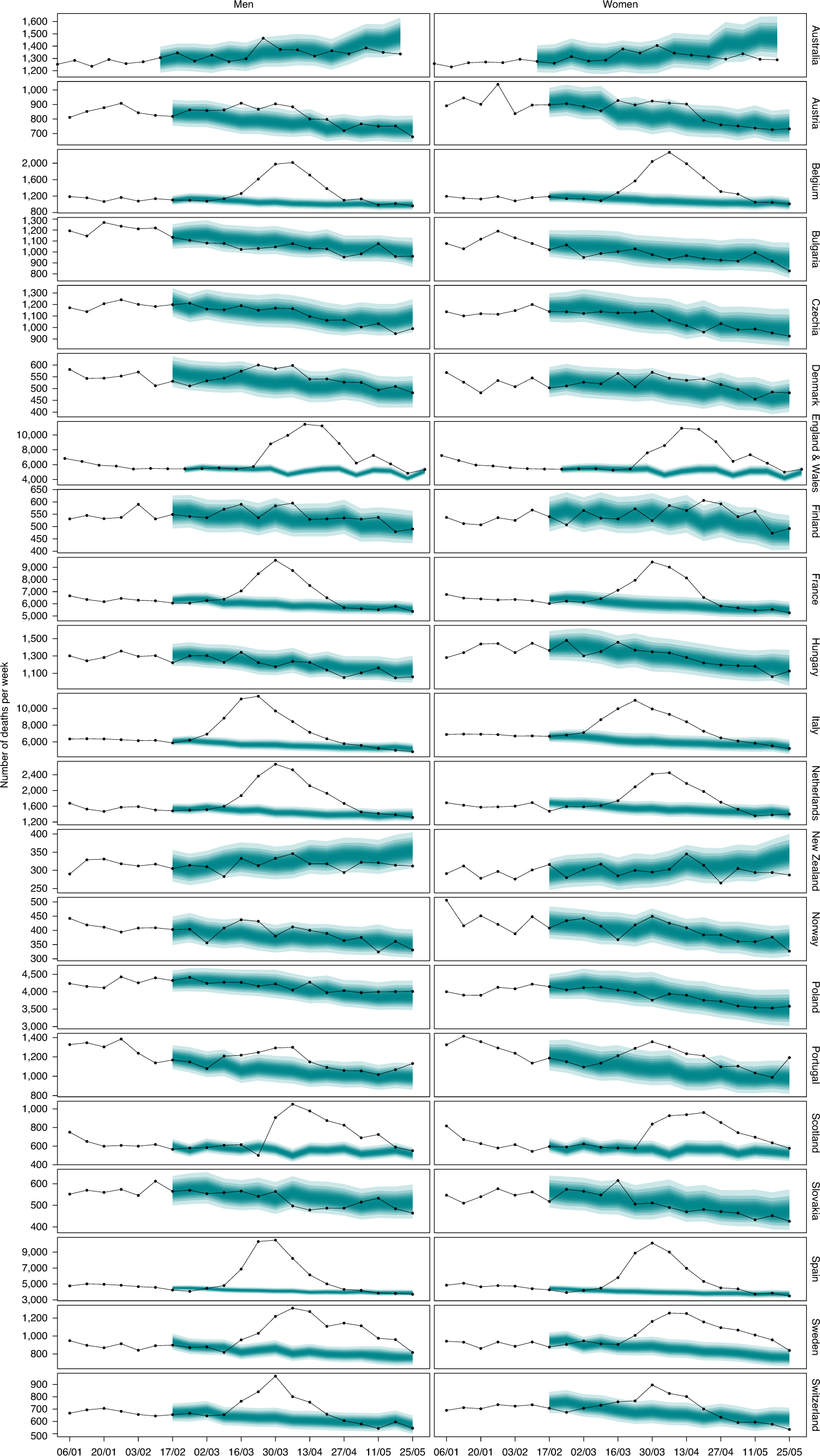
Fig. 1 

Tracking covid-19 excess deaths across countries: In many parts of the world, official death tolls undercount the total number of fatalities


Reports of Sweden's deaths highly exaggerated

Reports of Sweden's deaths highly exaggerated: As the governments of Europe began reimposing lockdowns this week, the pro-lockdown media have been reminding us what happens to bad governments that fail to shut down their societies; the favorite cautionary tale, as always, being that of Sweden. "The Swedish COVID-19 Response Is a Disaster," Time magazine headlined October 14. On October 19, CBC Radio's "As It Happens" news show featured a "Swedish virologist [who] says her country's COVID-19 strategy has failed, but nobody will admit it." "As White House eyes 'herd immunity,' Sweden's no-mask approach is failing to contain COVID-19," Yahoo News chimed in on October 20, the same day a Washington Post headline reminded us that Sweden may have saved its economy, "But too many people have died." 

The story those sources tell is grim. "Sweden and the U.S.," Time declares, "are the only countries with high overall mortality rates that failed to rapidly reduce those numbers as the pandemic progressed." The Post warns that "deaths fell to low levels in August and early September but are now rising again." CBC tells us the Swedish health authority has been forced by the death toll to abandon its voluntary approach, and now "allows regions to institute local lockdowns 8 months into the pandemic" (although the story actually clarifies that these new local measures are not lockdowns: "there will be no legal or financial consequences for non-compliance)." Yahoo News quotes a "vocal group of Swedish health and science researchers and professionals, calling itself Vetenskapsforum (Science Forum) COVID-19," as claiming: "Sweden is actually today among the highest countries in the world when it comes to deaths per capita from COVID-19." Scary claims indeed; but do the numbers back them up?

Study helps explain declines in death rates from COVID-19

Study helps explain declines in death rates from COVID-19: a new investigation showed that by mid-August the death rate in those hospitalized with coronavirus-related illness had dropped from 27 percentage points to about 3 percentage points. Led by researchers at NYU Grossman School of Medicine, the study showed that a younger, healthier group of people were getting infected and were arriving at the hospital with less-severe symptoms than those infected in the spring. 

However, the researchers' analysis showed that these factors accounted for only part of the improvement in survival. The rest, they suspect, resulted from health care providers' growing experience with the coronavirus. For example, physicians learned that resting COVID-19 patients on their stomachs rather than their backs and delaying the use of ventilators as long as possible were more effective practices, say the study authors. Drugs likely helped as well. In addition, other factors such as decreasing hospital volumes, less exposure to infection, and earlier testing and treatment, may have played a role. 

"Our findings suggest that while COVID-19 remains a terrible disease, our efforts to improve treatment are probably working," says study lead author Leora Horwitz, MD, an associate professor in the Department of Population Health at NYU Langone Health. "Even in the absence of a silver-bullet treatment or vaccine, we are protecting more of our patients through a host of small changes," says Horwitz, who is also director of the Center for Healthcare Innovation and Delivery Science at NYU Langone.

Europe’s long Covid: things aren’t getting better any time soon

Europe’s long Covid: things aren’t getting better any time soon: Under the weight of such restrictions and uncertainty it is near-impossible for the economy to rebound. The government’s pledge to level up the country has been put on pause because the shutdown of business and economic activity has levelled down nearly every region outside of the south-east. Investment decisions are also on hold: not just cash to companies, but the investment employers make in their employees as well. Mass unemployment looms and bosses have no incentive to take on the financial risk of new workers, not when they might be told to shut their doors again. It’s nearly impossible to plan ahead with no vaccine or mass testing strategy in sight.

‘Dud COVID vaccines are no silver bullet’

Dud COVID vaccines are no silver bullet’: is there a mismatch between public expectations and what vaccine developers define as clinical “success”? If the vaccine is said to “work”, what exactly will it do? How certain is it that it will do this? And what are the implications for public health policy?

It is a common misconception that an approved vaccine will provide “silver bullet” immunity, a scenario based more on a Hollywood film narrative than reality because no COVID vaccine trial protocol defines its “success” as:

  • Providing immunity from infection from the SARS-COV-2 virus
  • Reducing mortality risk from the COVID-19 disease.
  • Providing immunity from COVID-19 disease symptoms

Instead trial “success” is defined as an amelioration of COVID-19 symptoms in 50-60% of volunteers, who are healthy adults likely to be at risk only from a mild or asymptomatic infection and thus not even a population group facing significant mortality risk from COVID-19. These dud COVID vaccines aspire to be buckshot not silver bullets: if they are the answer, what was the question?

Wikipedia and WHO collaborate to provide better coronavirus information

Wikipedia and WHO collaborate to provide better coronavirus information: The collaboration will give Wikipedia free use of WHO’s published information, graphics and videos for the online encyclopedia’s coronavirus content.